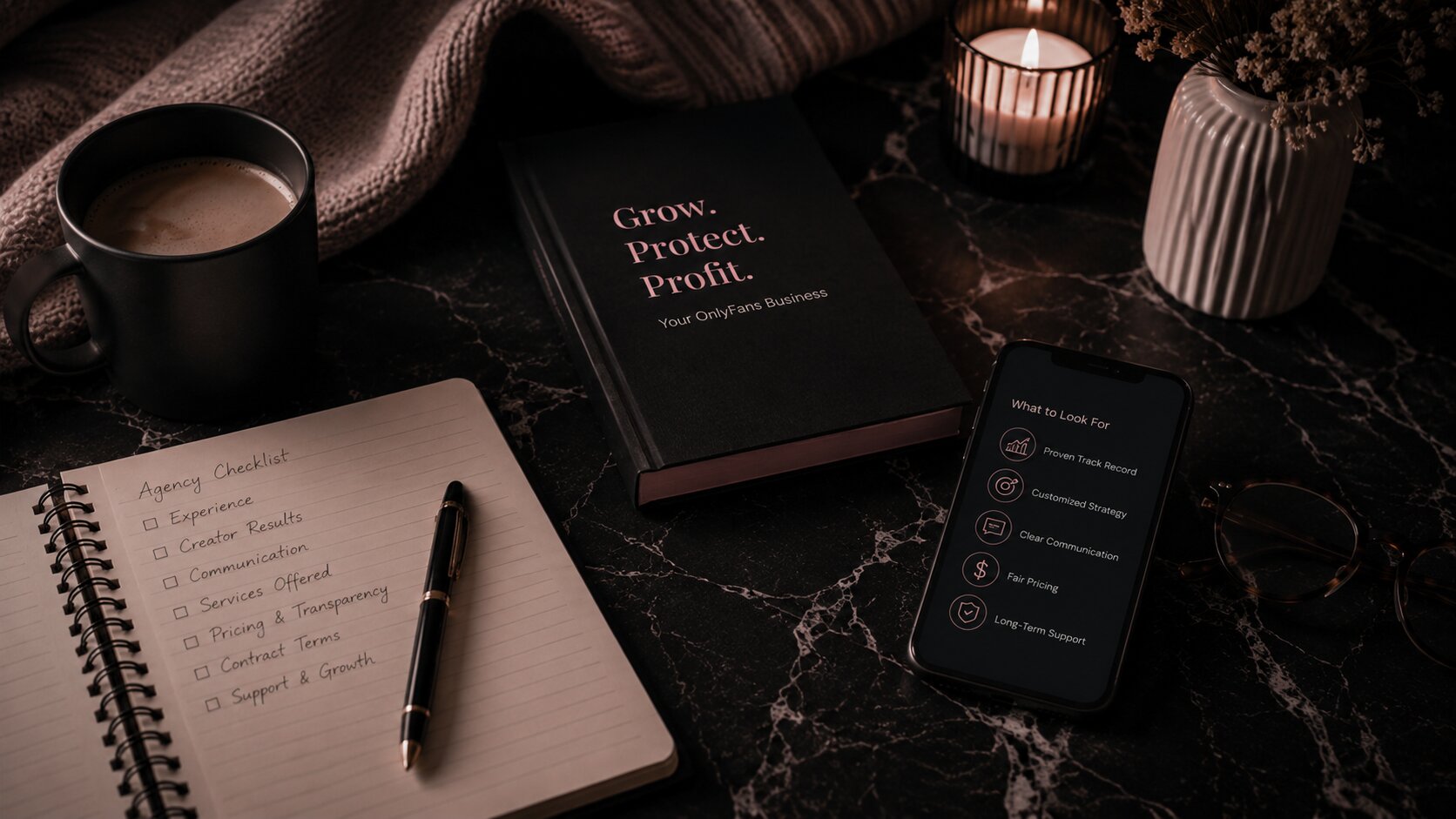
You’ve decided to sign with an agency. You open Google, you type “best OnlyFans agency 2026”. You land on ten different listicles, each ranking a different agency at number one. Coincidence? No. Most of these “guides” are written by the agencies themselves, or by affiliates getting paid for the placement. The system is broken.
Here’s what nobody publishes: a vetting framework that puts the choice back in your hands. Because picking the wrong agency at $20K/month means losing six figures over the next year, plus the time, the trust, and the momentum that took you years to build.
This guide isn’t a ranking. We deliberately don’t run one. Bias is unavoidable when you’re inside the industry, and we’d rather give you the tools to evaluate any agency yourself, including ours, on your own terms.
What you’ll get below: the four filters that should kill 80% of your shortlist before the first call, the seven questions that surface what an agency actually does versus what it markets, the signals to watch during discovery (often louder than the answers themselves), and the contract clauses worth pushing back on before you sign.
No listicles. No affiliate links. No “best agency” claims. Just the playbook we’d use ourselves if we were on the creator side of the table.
Let’s get into it.
1. Why Most “Best Agency” Lists Are Useless
Type “best OnlyFans management agency” into any search engine and you’ll find dozens of articles confidently ranking the top 10. Read three of them and you’ll notice something: the rankings rarely overlap, and the agencies at the top are almost never the same.
That’s not a coincidence. Most of those listicles fall into one of three categories. They’re written by the agency itself on a sister site, designed to look like a neutral review. They’re written by an affiliate, paid a commission for every creator who signs through their link. Or they’re written by content farms scraping the industry for SEO traffic, with no real expertise behind the rankings.
Reviews on Google and Trustpilot are similarly unreliable. Positive reviews are easy to manufacture; negative reviews can be buried with enough volume. Reddit and X carry some genuine signal, both pro and con, but you’ll have to wade through equal amounts of FUD, drama, and bad-faith competitor posts.
The only real signal is how the agency behaves when you talk to them. That’s covered later in this article.
We deliberately don’t publish a “top agencies” list, because we’d be biased and so is everyone else who does.
2. The 4 Pre-Qualifying Filters Before Your First Call
Before you take a single call, run every shortlisted agency through these four filters. Most of them will fail at least one. That’s the point.
1. Operating history
Two or more years of public operation is the safe baseline. The OnlyFans agency space has high churn, and many shops vanish within their first 18 months. Newer agencies aren’t automatically disqualified, but if they’re under two years old, they should be transparent about it and offer compensating signals: founder track record from prior agencies, stronger flexibility during the trial period, references from creators willing to vouch on their own initiative. If they’re hiding their age, that’s the actual red flag.
2. Verifiable business entity
A registered company (LLC, Corp, Ltd, or equivalent) operating under a real legal jurisdiction, capable of issuing proper invoices and tax documentation. A professional website with an “About” section explaining the business, multiple contact channels (form, email, WhatsApp), and consistent branding across them. Discretion about individual team members is normal and even expected in this industry, but the operating entity itself should be clearly identifiable. If the only point of contact is a Telegram handle and there’s no registered business behind it, walk away.
3. Operational depth
They can describe their structure clearly when asked: how many chatters, what shifts, what languages, what manager-to-creator ratio. Real operations explain themselves. Vague “we have a great team” claims, with no specifics behind them, are a signal of marketing-first, operations-thin shops that quietly outsource everything to underpaid freelancers.
4. Pricing transparency
A clear pricing structure publicly visible or willingly shared on the first call. Agencies that hide their pricing until call number three are creating leverage they shouldn’t need. For a deeper breakdown of what fair commissions actually look like in 2026, see our full guide on agency cost economics.
3. The 7 Questions That Separate Good From Bad
Bring this list to every discovery call. Ask the same questions across all 3 to 5 agencies you’re vetting and compare the answers side by side. Inconsistencies will surface fast.
1. “Who exactly will be chatting on my account, and what’s their structure?”
A real answer sounds like: native English chatters across three shifts, US/UK/AU based, low ratio per chatter, multilingual capability for high-value DMs from specific geographies. A bad answer sounds like “we have a big experienced team”, with no specifics. The chatters are the operational core of the entire service, ask about them in detail. Bloom’s full structure on this is laid out on our management page.
2. “Walk me through your general approach to driving traffic for a creator at my level.”
A good answer names specific platforms and tactics in their own words: Reddit subreddits and posting cadence, Instagram funnel architecture, geo-targeting strategy, a sense of what does and doesn’t work for creators in your revenue band. A bad answer leans on buzzwords without substance (“we use proprietary AI marketing systems”). Specificity beats sophistication every time.
3. “What does your discovery process look like? How long before we sign?”
A good answer describes a structured process: multiple calls, real questions about your situation, willingness to walk away if it’s not a fit. A bad answer is pressure to sign within 48 hours, no real questions about your goals, urgency framed as scarcity (“we only have one slot left this month”).
4. “Can I read the contract early, with enough time to review it carefully?”
Yes, sent before the final call, with time to read and run by a lawyer. Anything else is them wanting you to sign under pressure. “We’ll send the contract once you’re ready to sign” translates to “we don’t want you reading it carefully”.
5. “Is your commission on gross or net? Put it in writing.”
A good answer is calculated on net revenue (after OnlyFans takes its 20% platform cut), clearly defined. A bad answer dodges, claims “industry standard 40% gross” without breaking down what’s included or excluded. The gross-versus-net distinction can cost you tens of thousands per year on the same headline percentage. We broke down the full math in our agency cost article.
6. “What’s your contract length and exit policy?”
A good answer is 30-day rolling notice or a 6-month maximum term, clear exit terms, no exit fees, no IP or account claims after departure. A bad answer is a 12-month minimum, exit fees, vague “early termination penalty” language nobody can quote on the spot.
7. “What’s NOT included in your service that I might assume is?”
A good answer is an open list of exclusions: paid ads not included, content production not included, custom video edits billed separately if requested, personalized photography sessions outside the scope. A bad answer is “everything is included”, which is a red flag because no agency includes literally everything for a single commission.
4. Reading the Signals During Discovery Calls
Beyond the questions you ask, pay attention to how the agency behaves during the calls themselves. The signals are louder than the answers.
Green signals
- They ask questions about your specific situation (current revenue, content style, audience demographics, goals) before pitching anything. They want to understand the fit before selling it.
- They listen more than they talk during the first call. The pitch comes later, after they’ve actually heard you.
- They tell you when you’re not a fit, instead of pushing every creator into a contract. That kind of honesty is the strongest signal of operational confidence you’ll get on a discovery call.
- They explain trade-offs honestly. “Our model means we won’t be the cheapest commission on the market, here’s why” beats any glossy pitch deck.
- They follow up with relevant material tailored to your situation, not generic sales decks emailed to everyone.
Red signals
- They open with results: “we make our creators $50K/month”, before they’ve asked a single thing about you.
- They pressure you to sign within 48 hours, “spots are filling fast”, artificial scarcity used as a closing tool.
- They claim everyone benefits from their service, no qualifying questions, no acknowledgment that fit matters.
- They get vague when you ask about specifics (chatters, ratios, exclusions, contract terms). Vagueness on operational details means they don’t have them.
- They get defensive when you push back on a clause or a number. The contract phase is the calmest version of the relationship you’ll ever see; if they’re testy here, the post-signature dynamic will be worse.
An agency that handles your hardest questions calmly during discovery is the same agency that will handle your hardest moments after you sign. Behavior is the strongest predictor you have.
Want a discovery call that respects your time?
Bloom runs structured discovery: real questions about your situation, honest fit assessment, and a clear answer either way. No pressure, no fake scarcity, no 48-hour signing windows. If we’re a fit, you’ll know. If we’re not, we’ll often point you toward an agency that is.
5. Contract Red Lines: Demand These, Refuse Those
Read the contract carefully, twice, and have a lawyer read it once. The clauses below are the ones that determine whether the relationship works in your favor or against you when something goes wrong.
Demand these clauses
- 30-day rolling notice OR a 6-month maximum contract term. Never longer locked-in periods that survive the agency’s quality.
- Commission calculated on net revenue (after OnlyFans’s 20% platform cut), not gross. Get this in writing with a worked example.
- DMCA protection included as part of the core service, not billed as a separate upsell. We covered why this matters in our DMCA protection guide; leak removal isn’t optional in this industry.
- Account ownership and login credentials remain in your name, with your access maintained at all times. Even during the contract.
- All content and intellectual property rights stay with you, the creator. Always.
- Clear definition of what triggers the contract, what services are delivered, and what counts as “delivered” for billing purposes.
Refuse these clauses
- Non-compete clauses extending after the contract ends. You should be free to work with another agency, or solo, the day after notice expires.
- “Right of first refusal” on future agencies for 12+ months after contract ends. Same logic.
- Any clause transferring account ownership, even temporarily, even framed as “operational convenience”.
- Mandatory content production through a specific studio, photographer, or videographer the agency owns or partners with. That’s a kickback structure dressed as a service.
- Vague “additional fees as needed” language without defined caps. Anything not capped will inflate.
- Auto-renewal clauses that don’t require explicit re-signature. The renewal decision should be active, not passive.
Spend $300 to $500 on a one-hour consultation with a contract or entertainment lawyer before you sign anything. On a contract that could route 30% to 50% of your revenue for months or years, this is the highest-ROI legal spend you’ll make in this industry.
6. Why 30-Day Rolling Beats Long-Term Lock-In
A lot of agencies will pitch you on a long-term contract framed as a “commitment” that proves you’re serious about growing. The framing is backwards. The commitment should be the agency’s, to keep delivering every month.
The cleanest test of contract structure is this: who carries the operational pressure?
In a 12-month locked-in contract, the agency has structural leverage regardless of performance. The honeymoon period might be excellent. Month four can quietly slide. Month seven, your revenue plateaus and you’re still locked in for another five months. The agency has no business reason to fix the dip; you can’t leave. The pressure is entirely on you.
In a 30-day rolling contract, that dynamic flips. Every single month is an active renewal decision. The agency’s revenue depends on their delivery, not on a signature you gave eight months ago. Quality compounds because it has to.
If an agency refuses 30-day rolling, ask them directly: “What about your service makes you confident you can’t deliver on a month-to-month basis?” Their answer (or the way they dodge it) tells you everything. Real operators are willing to be judged by their last 30 days of performance because they trust their own work.
Bloom uses 30-day rolling on every contract, both Chatting and Full Growth plans. We believe the agency that earns your renewal monthly is the one worth signing with. The structure also forces our internal operations to stay sharp, because complacency shows up in the next renewal cycle, not after a year of trapped revenue.
7. How Bloom Approaches the Vetting Process (From Both Sides)
We’re going to be direct about how we run discovery, because the way we vet creators is the same way we’d want to be vetted.
Bloom turns creators down more often than we accept them. Not for ego reasons; mismatched creators waste both sides’ time and energy, and damage everyone’s outcomes when forced. We say no when the fit isn’t there.
Discovery is structured: multiple calls, real questions about your current situation (revenue, content, audience, goals), mutual fit assessment. We tell you upfront if we don’t think we’re the right agency for you, and we’ll often refer you to one that is, even when that costs us a signed contract.
Two plans, both transparent:
- Bloom Chatting: full account management without traffic generation, for creators who already have their own audience and just need the operational layer. Tier 3 commission, 20% to 40% on net revenue.
- Bloom Full Growth: full-service including organic multi-platform marketing across Instagram, TikTok, X, Reddit, Threads, Telegram, and YouTube Shorts. Geo-targeted to USA, UK, AU, Canada, Nordics, Western EU. Tier 4 commission, 50% on net revenue.
Both plans use 30-day rolling contracts. No long-term lock-ins. DMCA protection is included by default in both, never an upsell.
Our manager-to-creator ratio is intentionally low (two dedicated managers per one to three creators), which is also why we accept fewer creators than most agencies. You can see how it all fits together on our pricing page.
If you want to see how this looks in practice, send your numbers on WhatsApp. We’ll tell you honestly whether you’re a fit, and if you’re not, we’ll often point you toward an agency that is.
8. The Bottom Line
- Ignore the listicles. Build your own shortlist using the four pre-qualifying filters in this article.
- Ask the seven vetting questions on every call. Compare answers across three to five agencies side by side.
- Read the signals as much as the answers. How they behave during discovery is how they’ll behave after you sign.
- Have a contract lawyer review before you sign. Always. The $400 spend is the cheapest insurance you’ll buy.
- Prefer 30-day rolling contracts over long-term lock-ins. The agency that earns your renewal monthly is the one worth signing with.
The right agency for you will answer every question patiently, more than once, without pressure. The wrong one will rush you. Listen to that signal.
Frequently Asked Questions
How long should I take to vet an OnlyFans management agency before signing?
There’s no fixed timeline that fits every situation. Quality matters more than the number of agencies you talk to or the number of weeks you spend doing it. The right fit usually surfaces within 2 or 3 serious conversations, when one agency clearly listens better and asks better questions than the others. Trust that signal when it appears, and take the time you need to feel confident about the fit before you sign.
What’s the most important thing to evaluate when choosing an OnlyFans agency?
How they behave during discovery, more than what they claim about results. An agency that asks thoughtful questions about your specific situation, listens more than it talks, and openly tells you when you are not a fit is operating with the patience of a real long-term business. Pressure tactics, generic pitches, and vague answers signal the opposite.
How do I evaluate an OnlyFans agency’s claims about their results?
Three layers. First, check whether their results claims are specific (timeframes, growth ranges, scenarios) versus generic ‘top creators’ headlines without context. Second, search the agency name on Reddit and X to see what creators say outside curated testimonials. Third, see whether they’re willing to walk you through their methodology in detail, not just outcomes. Agencies confident in their process explain it; agencies confident only in their marketing don’t.
Should I work with a beginner-friendly agency or wait until I’m bigger?
It depends less on your current revenue and more on three signals: you’re posting consistently, your audience is growing month over month, and operations are eating into the time you’d rather spend creating. If those three are checked, an agency conversation is worth having regardless of whether you’re at $5K or $25K. The right agency for you will look at your trajectory, your fundamentals, and the fit, not just a revenue threshold. The wrong fit will reject you for being ‘too small’ without looking at your potential.
Can I vet multiple OnlyFans agencies at the same time?
Yes, and you should. Talking to 3 to 5 agencies in parallel lets you compare answers to identical questions, surface inconsistencies, and gives you negotiating leverage when you find your top 2. Be transparent that you’re vetting multiple options. Quality agencies will respect that.
What contract length should I demand from an OnlyFans management agency?
30-day rolling notice is ideal. Some quality agencies use 3 to 6-month minimums, which is acceptable when paired with clear exit terms. Anything beyond 12 months locked-in is a red flag. The agency that earns your renewal through results does not need legal chains to keep you.
How much should I budget for a contract lawyer to review an OnlyFans agency contract?
$300 to $500 for a one-hour consultation with a contract or entertainment lawyer. They’ll catch IP assignment clauses, account ownership transfers, non-compete language, automatic renewal terms, and exit penalties you wouldn’t notice on your own. On a contract routing 30% to 50% of your revenue for months or years, this is the highest-ROI legal spend in this industry.
What’s a fair commission percentage for an OnlyFans management agency?
It depends on what’s included. Chatting-only services generally fall in the 20% to 40% range on net revenue, full-service with traffic generation typically lands around 50% on net. The percentage matters less than what you actually receive for it. A 30% commission for a low-quality service is more expensive than a 50% commission for a complete operation that grows your revenue 2 to 3x. Read our full breakdown on agency cost economics for the math.
Written by the Bloom Creators House team. We’re a US-based OnlyFans management agency working with select creators between 10K and 500K+ followers. If this article resonated, book a free 30-minute call on WhatsApp and we’ll walk you through your specific situation honestly, no pressure.